
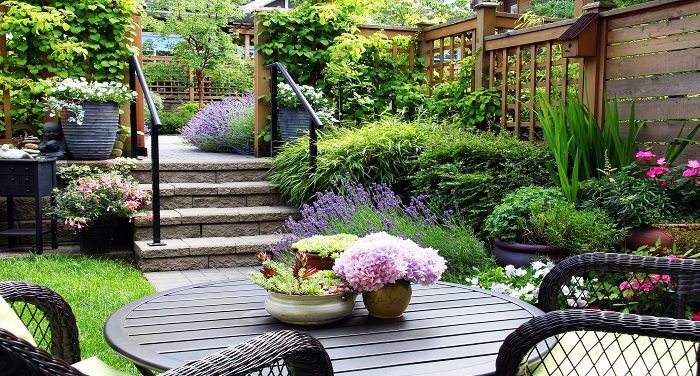
5 Landscaping Ideas For Small Gardens
There is an assumption that whenever the word landscaping is used, it refers to huge landscaping projects, such as those you might see around large office complexes.
Even when landscaping is discussed within the context of domestic gardens, it is often thought to apply only to the sprawling gardens of large homes.
This shows that landscaping is a gardening term that relates to the actions being carried out rather than any particular location or garden.
As such, landscaping is an activity that can be done in a small garden, and often with as much enjoyment as it would be in a garden 20 times the size.
Good landscapers do not suggest that you can do everything in a smaller area than you could in a large area, so landscaping in a small garden will require some imagination.
However, there are lots of ideas for what you can do in a small landscape garden, and here are five that we hope you might try.
Create Pathways
One goal of many who have a small garden is that they still do not want to spend as much time maintaining it. One way to achieve this is to reduce the area and the number of plants needing that maintenance.
A clever way to achieve this is to include one or two small pathways, especially across any lawn area. This can be done using shaped paving slabs, which look great and reduce the grass area that needs to be mown each time.
Build On Multiple Levels
If you wish to make your small garden appear to be bigger than it actually is, then you should create it on multiple levels.
This can be done in many ways, such as having a sunken part of your garden, having a multi-tier deck, having plants on different levels, or having a raised patio.
It may not accurately add massively to the square feet you have available, but visually it will generate a feeling of increased space.
Use Evergreens Instead Of Deciduous Plants
Another way to reduce the amount of maintenance in a small garden is to reduce the amount of raking and sweeping of leaves that have fallen on the ground.
The obvious way to do so is to replace any deciduous plants and trees, which by their nature shed their leaves, with evergreen plants and trees which do not shed their leaves.
Given you are working within a small garden you should select evergreen plants that will not grow to be too big, and that are easy to prune.
Use Rocks As Features
Rocks should be seen as one of a landscape gardener’s best friends as they have so many uses within a garden.
In small gardens they can be used to create walkways, used to build wonderful features and they can be used for practical purposes such as the base for a table, and even as seats.
Whichever way you use them, rocks also offer some wonderful visuals given that each one is a unique shape and they come in a variety of sizes and colours.
Replace Natural Grass With Artificial Grass
We return to the desire to reduce maintenance within a small garden and one of the most obvious ways to achieve that is to eliminate the need to mow the lawn.
You do so by replacing the turf with artificial grass, and with advances in manufacturing technology, the artificial grass of today looks and feels more like the real thing than it has ever done.